
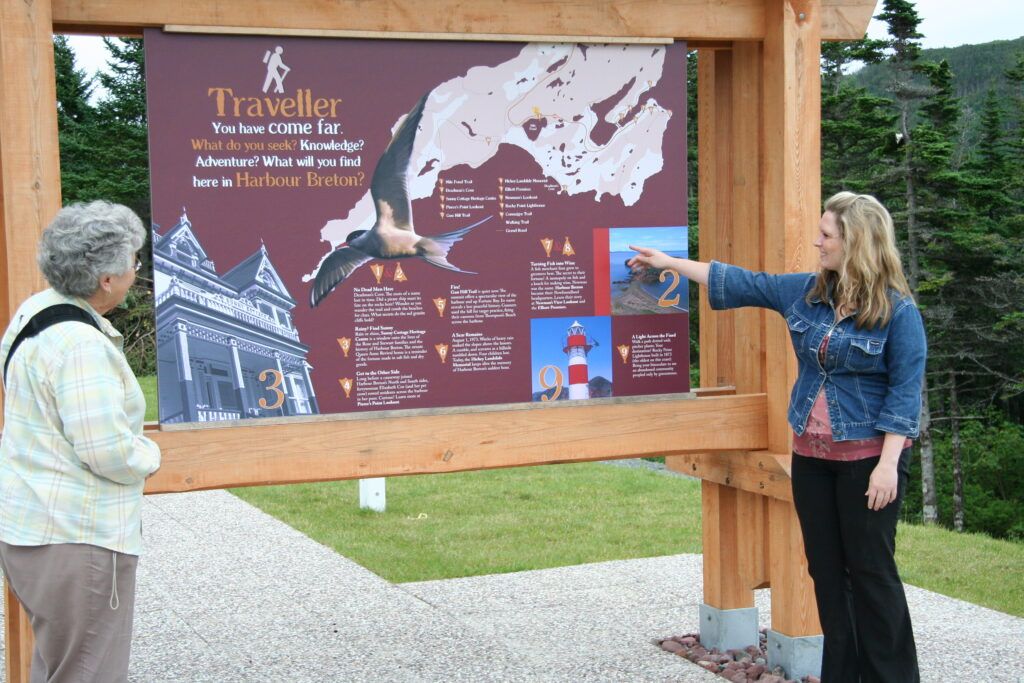
Travelling in Newfoundland is very rewarding, but even more so when you leave the well travelled routes and explore the more remote areas. Harbour Breton is located at the end of Newf-360, the Bay D’Espoir Highway. One of the things that make the drive enjoyable has to be the ever-changing scenery. An undulating road passes through dark forests at times, and at others climbs onto the glaciated regions where the rock is at the surface, soil is shallow, and sometimes sparsely covered with vegetation grasses, bushes, and small trees.
This is a great way to see the quiet, peaceful little villages of this beautiful province, and leave the crowds behind. This is a good road that leaves the TransCanada highway at Bishop’s Falls and travels southward for 200 kilometres. This is real wilderness.
Nearer to the coast the route climbs somewhat, eventually twisting along the fjords. This part of the highway has several areas where you can stop and view the scenic fjords and waters of the Bay. Some of the cliffs along here are really steep, and if you go wandering off for a better place to get a picture, you must be careful of the loose soil and rock along the tops of the fjords. You also are likely to view moose, or caribou as the streams, ponds, and open areas present excellent forage places.
A long descent through the glaciated valley brings you at last to Harbour Breton. This area, when covered by the great continental glacier, was depressed more than 20 metres. The outside is a magnificent piece of architecture and the inside has all the beautiful rooms, banisters, and woodwork one expects to find in such a place. If you get the opportunity to go to the roof, you can stroll around in the Widow’s Walk, a place where wives stood to watch for their husbands coming into the bay in their fishing boat, home safely at last, although sadly, not always true. It’s generally a quiet walk, and when the ocean is smooth you can see down to the bottom, and observe the roving fish.
The settlement is located in a protected bay surrounded by green topped cliffs with sheer drops on most sides. That resulted in the ocean levels being much higher. In the bedrooms you will see the pitcher and vases for hot and cold running water, as long as the maid was doing her job. If you are camping, what a restful stop you’ll have in their bay side park, which is available for picnicking, and camping. In the other direction there is a walking trail up to the top of Gun Hill.

This is a very old fishing centre and probably the largest and most important of all the scattered communities in the area. When melting began, the run-off, carrying sand and gravel, created a large flat topped delta. You will see a table set for supper with the best china. Your view across the beach, backdropped by the mountains, is a perfect reason to come here. It’s a stiff walk, so I suggest you take your time to stop here and there and enjoy the beauty of the place.
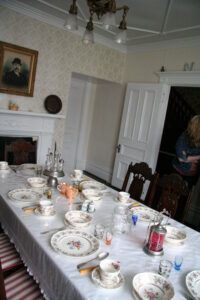
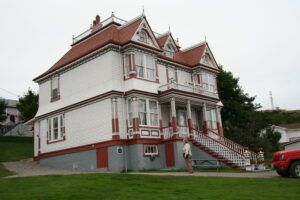
As is the case for most of the settlements, the homes with their colourful paint jobs and coloured roofs are outstanding in their appearance. The land rebounded after the ice had melted, and part of the town is now sitting on the side of the delta where the glacier came to rest. The people who lived here, lived in comfort, and style. There are 5 sites with water and electrical, 10 tent sites, and washrooms with showers. If the weather is on your side, you can get amazing pictures that include the green of the mountain sides, and the very, very blue of the ocean waters.
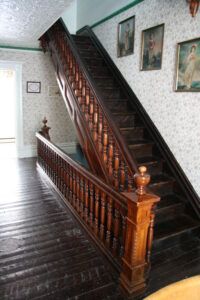
The village’s location is the result of the glacier. Make sure you get a chance to visit Sunny Cottage Heritage Centre, and see the beautiful Queen Anne type home built in 1907. Period dressed guides tour you through the building with an opportunity to taste test the traditional food. A pleasant stroll from the campground will take you along the shores of Deadman’s Cove.
Be sure to stop and pick up a map of the town at the Elliott Premises. There will likely be trail maps too. The town considers itself a walking town, and that’s definitely a perfect way to move around, especially if you are going to take time to investigate and discover the hidden treasures of Harbour Breton. The many trails will provide you with some exercise, and great viewing enjoyment.
When you are in the area, you might explore some of the other ocean settlements. The sea was a way of life for the settlers here. You don’t see many areas suitable for farming, but fishing sustained their lives. The boats were their means of making a living, and a way to get to other places. Roads have only appeared in later years. As you go to each port you can see by the buildings, that these people had a good life, although hard at times.
St. Alban’s offers hiking trails and fishing. It is an important region for growing Steelhead salmon and rainbow trout taking advantage of the warmer waters of the southern coast. In the 1760’s, Captain James Cook spent much time mapping the coast at the request of England. Cook’s Landing has Interpretation signs to show the explorations of Capt. James Cook and his visit there during his mapping of the island.
Drive to Conne River to visit the Miawpukek Nation. This is a unique reserve where you can explore a Mi’kmaq village and visit the Arts and Crafts store. In early July there is a big Powwow and people come from great distances to attend the festival. Camping is available at the Jipujij’kuei Kuespem Nature Park 12km away.
All over Newfoundland there are similar long sideroads that run from the main highway to distant settlements on the ocean. We have visited a great many of them. The drives were often long, but always enjoyable for their scenery. The people we met, always friendly. Visit soon!
-30-
Happy RVing !
For more than four decades James Stoness has travelled the roads of North America, photographing and writing about what he has seen. His travel articles and beautiful pictures have been published in several magazines and newspapers. He is also the author of five western novels, a science fiction novel, and an adventure novel.