
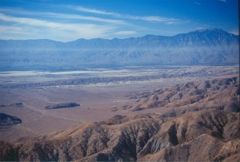
More and more of the snowbirds who have been frequenting the coasts of Florida and Texas are spending their winters farther west. They have discovered the beauty of the desert. Low humidity, sunny skies, and long picturesque views have won them over. Of course, winter is the best time to visit the deserts. Temperatures range from cool to comfortably warm. Most crawly creatures are sleeping away their ‘winter’ and the weather is great for visitors to get out and walk among the strange desert vegetation.
One of the very scenic drives is found in eastern California passing from Death Valley NP south through the Mojave Preserve to Joshua Tree NP. It’s a drive filled with a variety of desert scenery.
The bajada is a feature not observed where there is a lot of vegetation. It is a broad apron of debris accumulated around the cliffs and the resulting view is that of a sea of small mountains surrounded by sloping oceans of sand.
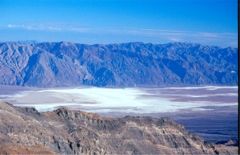
This route roams across desolate flat lands and up and down numerous small mountains. There are always mountains in view and as you approach the tops of the ridges you never know when you will be entranced by a wonderful jumble of blue mountains and hidden valleys where you can see wave upon wave of purple ridges rolling to the horizon.
Normally, we would take this trip south from Furnace Creek, in Death Valley NP but the summer of 2004 arrived with deadly floods that have closed many of the roads in the south of the park. Instead I suggest going west from Las Vegas to Shoshone and heading south from there.
Many highways do not have installed culverts. Instead there is a dip in the road where the water crosses. Most have warning signs that tell you not to enter when water is flowing. You might wonder if water ever flows there but a careful look at the erosion at the end of the dip, or at the sand and stones strewn across the pavement might change your mind. Cars do get carried right off the highway from the force of the water in these flooded dips.
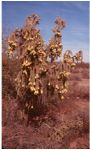
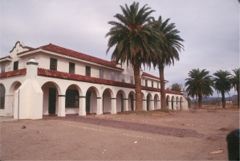
In the Mojave Preserve, a long descent through cacti and creosote bushes takes you to Kelso Station, an old railway station of beautiful Spanish architecture that may become the new park headquarters for the vast Mojave Preserve. The nearby Kelso Sand Dunes rise to over 600 feet above the desert floor in a profusion of shapely curves that extend far down the valley. Although difficult to climb it might be worth the effort just to slide down one of the steeper faces, or to listen to the music of the sliding sand.
Eventually, you make another winding climb before rolling down another long slope to Amboy where the flow from an ancient volcanic cinder cone left a streak of black lava across the dry sands toward dry Bristol Lake. On the lake, sand dikes surround evaporation ponds used to collect salt.
For miles the vegetation changes from lowland desert plants to highland varieties and back again as the roller coaster ride continues, taking you to the top of the Granite Mountains where erosion is creating strangely sculptured pillars and scattered piles of massive boulders.
In the town of Twentynine Palms artists have painted beautiful murals with western themes onto the sides of buildings. In nearby Yucca Valley, Hollywood has captured the beauty of the surrounding area on film in ‘It’s a Mad Mad Mad Mad World’.
For more desert scenery head south into Joshua Tree NP which has a fantastic variety of eroded mountains, huge boulders, and a couple of cactus patches.
For more than five decades James Stoness has travelled the roads of North America, photographing and writing about what he has seen. His travel articles and beautiful pictures have been published in several magazines and newspapers. He is also the author of five western novels